










The short answer: book for the thing you can’t compromise on. If the tools or materials are the reason for the trip, and there are no more people than the van has seats, a van is usually right. If the trip is mostly about getting people to meetings, inspections or site walks, and the kit fits in a boot, a car is usually right. When you need both lots of people and lots of kit, the honest answer is often two vehicles.
Where people go wrong is choosing by habit. A van feels like the “work” option and a car feels like the “travel” option, but the right choice depends on four things: how many people, how much kit, where it sleeps at night, and where you need to park.
Anyone used to planning journeys around timetables and routes will recognise the approach. Decide what the journey has to carry first, then choose the mode that carries it, rather than the other way round.
The car-versus-van selection grid
Work down the left-hand column and note which side each answer points to. If most answers point one way, that’s your vehicle. If they split, read the section below on splitting the job.
| Question | Points to a car | Points to a van |
|---|---|---|
| How many people travel? | Three to five, needing proper seats for long drives | One to three, all fitting in the van’s cab seats |
| How much kit? | Hand tools, laptops, survey instruments, a couple of cases | Power tools, ladders, stock, materials, anything longer than a boot |
| Does any item need to lie flat or stay upright? | Rarely | Often: sheet materials, pipework, cylinders, display kit |
| Where does the kit spend the night? | In your room or a locked building | Too much to unload nightly, so the van needs a secure spot |
| Where will you park? | Hotel car parks, town centres, client offices | Site compounds, industrial estates, places with room to load |
| Any city-centre driving? | Usually simpler | Check emissions zone rules and loading restrictions first |
One line overrides the rest. Passengers ride in seats. If the team outnumbers the van’s cab seats, the extra people go in a car. Nobody travels in the load area, even for a short hop between sites.
Licences and the bigger vans
Most panel vans are fine on a standard licence. Category B covers vehicles up to 3,500kg maximum authorised mass for petrol and diesel, according to GOV.UK’s licence categories. Some larger vans and anything described as a light truck may be heavier, so check the plated weight of the actual vehicle you’re offered, and make sure every person who might drive is named on the hire.
Where the tools sleep: the security question
On a multi-day trip this is often the deciding factor. A van full of power tools parked outside a guest house overnight is a known target. Van security advice from Police Scotland, published by Scotland Trusted Trader, recommends parking in well-lit, overlooked spots, ideally covered by CCTV, and suggests stronger locks, door guards, a bolted-down tool vault and recording serial numbers.
A hire van won’t have your own vault or extra locks, so plan around that.
- Ask your accommodation in advance about secure or overlooked parking, and whether a van will fit.
- Photograph and list serial numbers of expensive tools before you set off.
- Take the most valuable items indoors each night, even if it’s a nuisance.
- Reverse up close to a wall where it’s safe to do so, so the rear doors can’t easily be opened.
If none of that’s practical, it may point towards a car, with the bulky but low-value kit sent ahead or sourced locally.
Two worked examples, two different jobs
Example one: a hypothetical fit-out week in Lanarkshire
This case is invented for illustration. Two installers from an English contractor are spending five days fitting shelving and electrics in a unit near Motherwell. They’re taking power tools, a stepladder, two boxes of fixings and lengths of trunking that won’t go in any car. There are two of them, so both fit in a van cab. The unit has a yard where the van can be locked in overnight, and their hotel is ten minutes away.
Every row of the grid points to a van. They could travel up by train and hire locally rather than drive their own van the whole way. The Motherwell van hire options page lists vans from compact and automatic models through Transit and long-wheelbase vans to Lutons with tail lifts, and says it offers free local delivery and collection in Motherwell and the surrounding area. They would ring with the dates, the length of the trunking and both drivers’ details, then confirm the deposit, insurance excess and whether the van can be delivered to the site. If any of the week’s work were in Glasgow city centre, they’d also check the van against the city’s emissions rules. There are four Low Emission Zones in Scotland, including Glasgow, according to mygov.scot, which links to an official vehicle checker.
Example two: a hypothetical survey trip in Lochaber
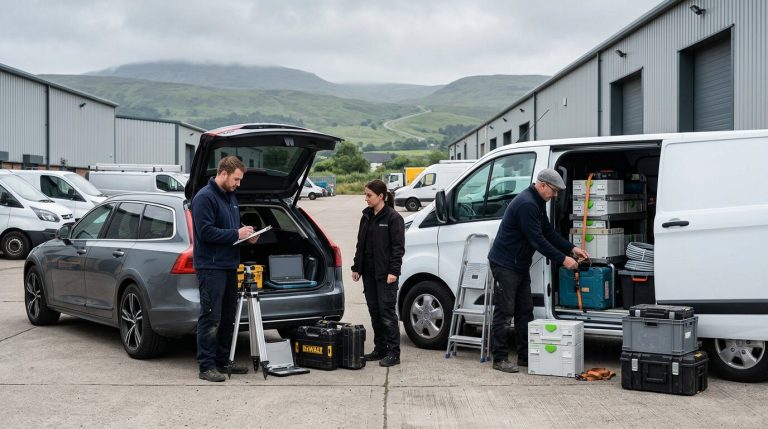
A separate invented case. Three surveyors are visiting several sites around Fort William over two days. Their kit is a tripod, a laser level, laptops and safety gear: bulky enough to fill a boot, but nothing that needs a load area. Three people need three proper seats, and the evenings involve a hotel car park in town.
Here the grid points to a car. The carhirefortwilliam.co.uk booking information lists cars from a Fiat 500 up to estates and SUVs, and says it delivers to and collects from your location in Fort William. An estate would suit three people and a tripod. They’d confirm the boot space of the specific car, the deposit and the return arrangements before booking, and take the laser level and laptops into the hotel each night.
When the answer is both
Some trips genuinely need a car and a van: four people and a full load, or a team that splits between sites during the day. Two vehicles cost more to hire, but they also mean two drivers, two parking spaces and no temptation to squeeze an extra person into a space that isn’t a seat.
Make the decision on paper before anyone books. Count the people, list the kit, decide where it sleeps, and check where you’ll park. The vehicle almost picks itself.